She Needs Me to Leave With Her

There are some things we spend years trying to understand because we believe understanding them will finally allow us to put them down.
We gather the pieces. We revisit old conversations. We search through records we haven't looked at in years and compare dates against memories, policies against actions, what should have happened against what actually did. We find people who were there and ask what they remember. We reconstruct rooms, conversations, sequences of events. We become archaeologists of our own lives, carefully brushing dirt away from something buried long ago because some part of us remains convinced that if we can uncover the entire thing—if we can finally see every piece of it clearly—then maybe we will understand why it still hurts.
Sometimes that work matters.
Sometimes we discover that the story we have carried about ourselves was never true.
And sometimes, somewhere in the middle of all that digging, we have to ask whether we are still searching for answers or whether we have quietly begun trying to earn permission to believe ourselves.
I found myself standing directly inside that question this week because of a grizzly bear.
A one-year-old grizzly bear, actually.
Which somehow makes this story both more absurd and more perfect.
The bear left his enclosure at a zoo. Nobody was injured. The public wasn't yet inside. He apparently wandered around for a while before being immobilized and safely returned to his back-of-house space.
By every account available at the time, the outcome was good.
And yet the response was immediate.
Emergency procedures were activated.
Animal care responded.
Security responded.
Police responded.
The affected area remained closed while an assessment was completed.
The institution publicly acknowledged what had happened.
And they announced that the circumstances would be reviewed under their established post-incident procedures.
I read those words and something inside me cracked open.
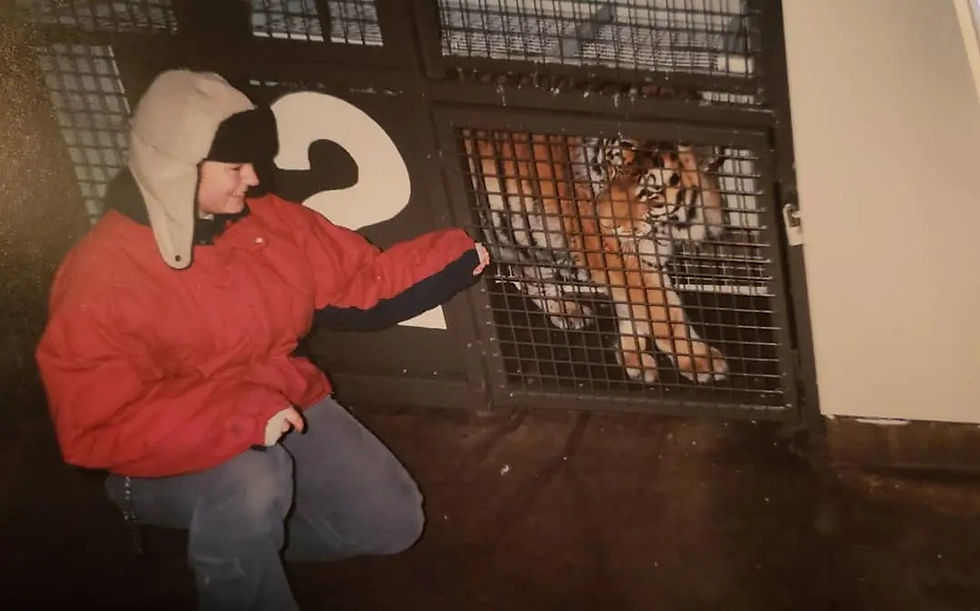
Because seventeen years earlier, I had been standing on the other side of a containment failure involving an adult Amur tiger.
And suddenly I wasn't reading a news article about a bear anymore.
I was twenty-six years old again.
---
Memory is strange when something frightening happens.
There are enormous pieces of that period of my life that have softened around the edges with time, but there are moments from that day that remain astonishingly clear.
The equipment failing.
The tiger responding to the compromised barrier.
My hands on the mechanism.
The awareness that other people were there.
The instinct to manage what was happening before there was time to contemplate what might happen next.
There wasn't a committee inside my head. There wasn't a philosophical conversation about bravery. There was no cinematic moment where I consciously decided what kind of person I wanted to be.
There was a problem.
I responded to it.
That is what trained animal keepers do.
And I handled it.
For seventeen years, however, the story that followed became far more complicated than the event itself.
Because when something serious happens and the response around you does not seem to match the magnitude of what your body just experienced, something strange can happen to your understanding of reality.
You begin wondering whether perhaps it wasn't actually that serious.
Maybe you overreacted.
Maybe you should have done something differently.
Maybe everyone else understands something you don't.
Maybe the fact that nobody was injured means there was never really danger at all.
The mind hates unfinished stories, and when nobody helps us finish one, we are remarkably good at writing ourselves into the empty spaces.
I wrote myself into mine for seventeen years.
---
Then a little grizzly bear went for a fucking walk.
And suddenly there it was.
A dangerous animal left containment, nobody was hurt, and still the response described publicly included emergency procedures, multiple responding teams, closure, assessment, review and acknowledgment.
I stared at it.
And I was angry.
Not elegant anger.
Not spiritually evolved anger.
Not the kind of anger that comes conveniently packaged with a lesson about forgiveness.
I was fucking furious.
Because I wasn't looking at proof that the 2026 response was excessive.
I was looking at something that challenged the standard I had used to judge my own experience.
The absence of injury did not mean there had been no incident.
A successful response did not mean there had been no danger.
The person who prevented an emergency from becoming a catastrophe did not thereby prove that the emergency had never existed.
That distinction landed somewhere deeper than intellect.
My body understood it before I did.
And suddenly I wanted to know everything.
---
I went down the rabbit hole.
Of course I did.
I searched old records. I revisited policies. I reconstructed timelines. I compared what I remembered against what I could document. I talked to people connected to that time. I separated what I could prove from what I suspected and what still required evidence.
And for a while, it felt incredible.
Not because what I was finding was pleasant, but because for the first time I was looking at the experience without automatically placing myself at the centre of its failure.
I didn't cause the equipment to fail.
That sentence seems almost insultingly obvious written here.
And yet there is a profound difference between intellectually knowing something and discovering how thoroughly your body has been living according to its opposite.
I didn't create the danger.
I was the person standing there when the safety system failed.
And I fucking handled it.
There is grief inside that realization.
Because once I stopped asking what twenty-six-year-old me should have done differently, another question appeared.
What should have happened for her afterward?
That question hurt much more.
---
I found myself grieving someone who technically never left.
The young woman who knew exactly what to do when an animal charged a compromised barrier but had absolutely no idea what to do with herself afterward.
The keeper who could manage an emergency and then quietly absorb the emotional consequences of surviving it.
The woman who interpreted the lack of institutional response as information about the legitimacy of her own experience.
The woman who eventually began wondering whether she had somehow failed because nothing terrible actually happened.
There is a particularly cruel form of hindsight that appears after we successfully prevent something bad.
Maybe it wasn't actually dangerous.
Maybe I made too much of it.
Maybe I should have done something differently.
And then there was the thought so ugly I could barely look at it without laughing at the sheer brutality of what I had been saying to myself:
I should have let her keep coming.
As though the only outcome that would have justified my fear was my own injury.
As though I needed teeth through the barrier before I was entitled to say the barrier failure mattered.
As though successfully protecting myself and the people around me somehow weakened the evidence that there had been something to protect us from.
At one point, describing this absurd internal logic, I said
I apparently should have let the tiger fold me through the feed chute void like a lawn chair.
Dark humour has always been one of the ways I metabolize things that are otherwise too enormous to hold.
But beneath the joke was something devastating.
Some part of me had spent seventeen years believing that maybe if the ending had been worse, someone would finally have agreed that the beginning had been serious.
That is not a belief I want to carry anymore.
---
There is another trap hidden inside finally being validated.
Once you begin finding evidence that supports something you have questioned for years, it becomes very difficult to stop.
One document leads to another.
One answer creates three new questions.
Every discovery delivers a tiny surge of relief.
See?
I knew it.
I wasn't imagining this.
And that relief is powerful when you have spent years doubting yourself.
But eventually I had to confront something uncomfortable.
At what point does searching for the truth stop serving me?
Because there is a difference between seeking accountability and requiring an airtight prosecution of your own memory before allowing yourself to believe what you experienced.
There is a difference between investigating something because answers matter and investigating because you have accidentally made your own reality conditional upon finding the next piece of evidence.
I can continue looking when there is something useful to find.
I can ask questions.
I can pursue accountability where accountability is appropriate.
I can preserve records.
I can correct inaccurate narratives.
I can call bullshit where bullshit belongs.
But I do not have to spend the rest of my life building an airtight case simply to earn the right to believe myself.
At some point, the evidence has to be allowed to do what evidence is supposed to do.
Inform us.
Not imprison us.
---
That realization brought me to the belief underneath almost everything else.
If I stop investigating, I am abandoning twenty-six-year-old me.
That one nearly got me.
Because I know her.
I know how alone she felt inside something she didn't yet have language for. I know how desperately she wanted someone with authority to look at what happened and say, Yes. That was serious. Yes. The equipment failed. Yes. You were put in danger. Yes. You responded well. Yes. We need to understand how this happened.
I know how much difference those words might have made.
So there is a part of me now that wants to go back and fight for her indefinitely.
Find every record.
Ask every question.
Trace every procedural failure.
Build the timeline so meticulously that nobody could ever dismiss her again.
Stand guard over the truth until my hands bleed.
It feels like loyalty.
It feels like protection.
It feels like finally becoming the person she needed.
But I am beginning to understand something.
She doesn't need another guard.
She doesn't need me to spend the next seventeen years standing at the same fucking chute.
She doesn't need me endlessly replaying the moment in order to prove that I haven't forgotten her.
And walking away from the evidence sometimes does not mean I am walking away from her.
Maybe the opposite is true.
Maybe staying there forever would be the abandonment.
---
There is a version of healing we talk about constantly that involves returning to our younger selves.
We imagine sitting beside them.
Comforting them.
Protecting them.
Giving them the words and compassion they didn't receive at the time.
I believe there is value in that.
But I think sometimes we forget the second half.
Eventually we have to take them somewhere.
We cannot spend our entire lives sitting beside younger versions of ourselves in the rooms where they were hurt.
At some point, we have to stand up.
Take their hand.
Open the door.
Show them everything that happened afterward.
Look at what you survived.
Look at what you built.
Look at how much you learned.
Look at all the animals you loved after this.
Look at the forests you walked through.
Look at the people who came into your life.
Look at the plants growing on your shelves and the aquariums glowing in the dark and the strange, beautiful life that continued unfolding despite the fact that on one July day you genuinely did not know what would happen next.
Come see it.
You don't have to stay here anymore.
Neither do I.
---
This does not mean pretending what happened was acceptable.
It does not mean forgiveness.
It does not mean abandoning questions that still deserve answers.
It does not require turning an institutional failure into some beautiful spiritual lesson I am supposed to be grateful for.
Some things are simply wrong.
Some things should have been handled differently.
Some people deserved better than what they received.
Healing does not require us to soften those truths until they become comfortable for everyone else.
But there is a difference between acknowledging an injustice and constructing a home inside it.
I can say what happened was serious without making seriousness the organizing principle of the rest of my life.
I can recognize what should have happened afterward without spending forever trying to retroactively manufacture it.
I can hold people and institutions accountable for what belonged to them without continuing to carry their portion myself.
And perhaps most importantly, I can stop asking the twenty-six-year-old standing at that chute to produce evidence for me.
I believe her.
I believe the equipment failed.
I believe she was scared.
I believe she acted.
I believe she protected the people around her.
I believe the absence of catastrophe was not evidence that she exaggerated the danger.
It was evidence that she responded to it.
She does not have to prove anything else to me.
---
Maybe this is what reclamation actually looks like.
Not rewriting the past.
Not finally uncovering the perfect document that makes everything hurt less.
Not winning an argument seventeen years after everyone else stopped having it.
Maybe reclamation is deciding that the person who survived no longer has to remain frozen at the site of survival.
I can continue seeking answers when those answers genuinely serve something.
I can demand accountability.
I can preserve the truth.
I can be angry.
I can grieve.
And I can also go pick herbs.
I can build aquariums.
I can write.
I can laugh at escaped baby bears going on unauthorized morning adventures.
I can create things that have absolutely nothing to do with what happened to me.
I can spend an afternoon thinking about plants instead of policies.
I can allow entire days to pass without returning to July 10, 2009.
None of that betrays her.
That is what she survived for.
For seventeen years I thought honoring her meant returning.
Returning to the moment.
Returning to the questions.
Returning to the evidence.
Returning to the anger.
Standing beside her over and over again and saying, I'm still here.
But perhaps she has heard me.
Perhaps she knows.
Perhaps there is nothing left for me to prove to the woman I used to be except that survival eventually gets to become a life.
So I am not leaving her behind.
I am not abandoning the keeper standing with her hands on that mechanism.
I am not asking her to forgive what happened or pretend she wasn't afraid.
I am simply reaching backward through seventeen years, taking her by the hand, and telling her something nobody could tell her then.
It's over.
You handled it.
You can let go now.
Because she doesn't need me trapped in July 10, 2009 with her.
She needs me to fucking leave with her.


Comments